This page was generated from the source of RoboHub. Edit the source, not this page.
The RoboHub keeper
The keeper is RoboHub's supervisor and front door. It signs people in for every
application, installs the applications and runs each as a systemd user unit from a
release it made, serves them under its own origin at /app/<name>/, and shows what
the machine needs to run them. It is the one page a person opens; Mesh, the
aquarium and energy are reached through it.
Reaching it
| Address | http://127.0.0.1:19090/ |
| Unit | robohub-keeper (systemd user unit) |
| State | ~/.rho/keeper (owner-only) |
| Its own settings | ~/.rho/keeper/data/settings.conf |
The keeper listens on loopback only. It signs people in over plain HTTP, so
reaching it from another machine belongs behind a TLS proxy;
KEEPER_LISTEN=0.0.0.0 ./scripts/deploy-keeper.sh opens it to every interface
anyway. robohub keeper reaches it from the orchestrator's command line too.
Installing it the first time is described in start/install.
Building and deploying
rho build .                      # build into build/keeper
./scripts/deploy-keeper.sh       # build, make a release, restart the unit on it
./scripts/deploy-keeper.sh --status
The service runs the release in use (~/.rho/keeper/apps/keeper/current), never the
checkout's build, so a rebuild here changes nothing until the next deploy.
ROBOHUB_ROOT says where the orchestrator (robohub) is when it is not beside this
checkout. Started by hand for a test:
ROBOHUB_ROOT=../robohub ./build/keeperApplications behind one origin
Every hosted application is reached through the keeper at
http://127.0.0.1:19090/app/<name>/ — Mesh at /app/mesh/mesh, the aquarium at
/app/aquarium/, energy at /app/energy/. The keeper's links, Open application
and the app switcher in every application's top bar go there.
A browser scopes cookies by host and not by port, so an application on a port of
its own would receive every other application's cookies, the keeper's admin session
among them. Through the keeper it never does:
- The
app_proxymiddleware (inproject.yml) serves/app/<name>/…from the
application's loopback port and never forwards the keeper'skeeper_session
cookie. - The application's own cookies are scoped to its path, and its root-relative links,
redirects and form targets are rewritten onto the prefix.X-Forwarded-Prefix,
-Hostand-Prototell it where it is reached. Server-sent events stream
through. - The list of applications and ports is
~/.rho/keeper/proxy.txt(name portper
line), which the keeper writes whenever its list of applications changes and the
proxy reads again when the file changes, so a newly installed application is
reachable without a restart. - An application signs in through the keeper's origin as well: its callback is
/app/<name>/auth/callbackon the keeper's port.
Each application still listens on its own loopback port, which is what the proxy
calls and what a script on the machine may use:
| Application | Name | Loopback port | First page |
|---|---|---|---|
| Keeper | keeper | 19090 | / |
| Mesh | mesh | 8478 | /mesh |
| Aquarium | aquarium | 8480 | / |
| Energy | energy | 8482 | / |
An application whose manifest port is already taken is given the next free one from
- To go back to linking each application on its own port, set
keeper.proxy_apps=off in the keeper's settings file.
Pages
| Page | What it is for |
|---|---|
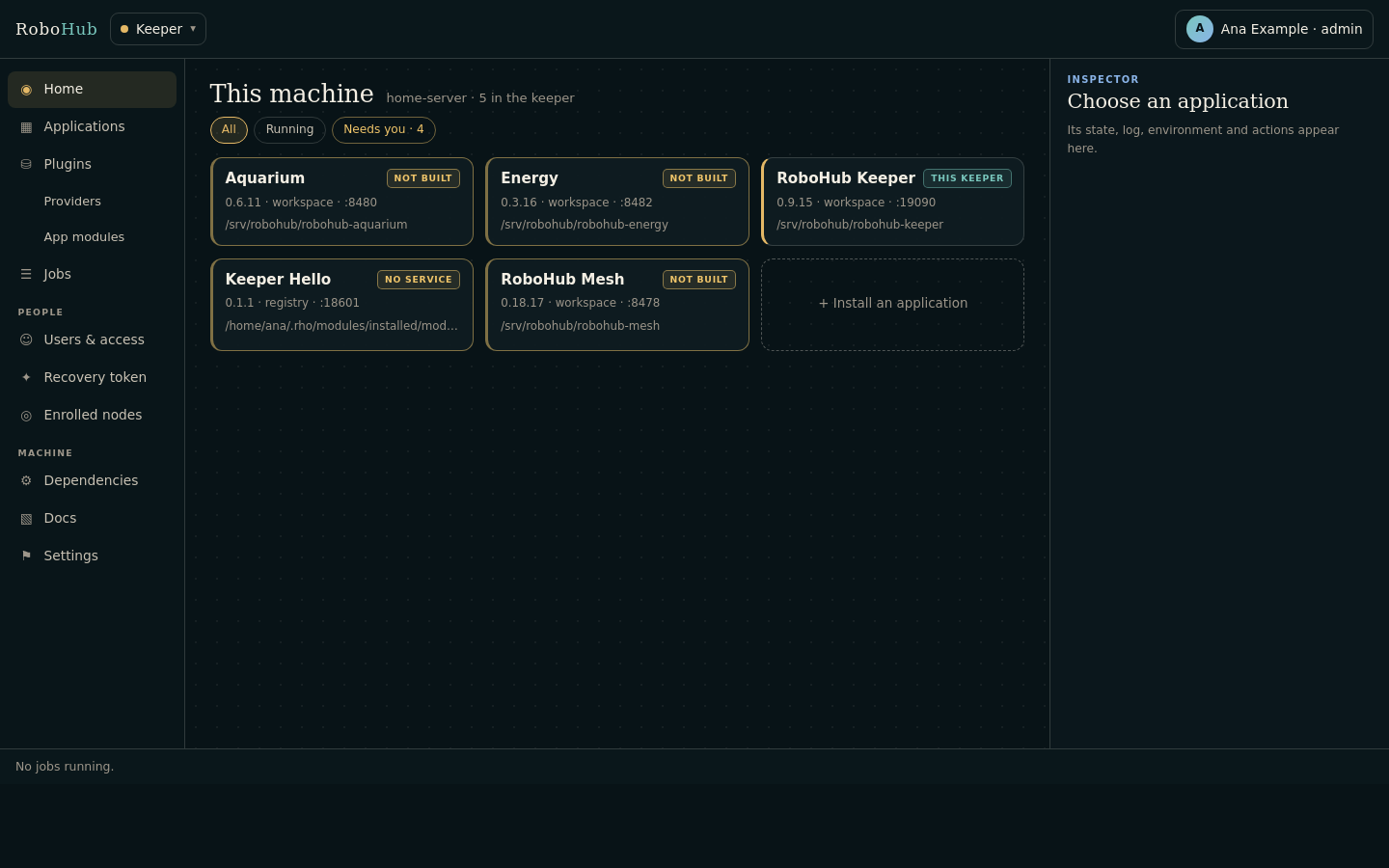
Home / | Every application as a card with its state, and an inspector beside them: folder, port, unit, release in use, journal, environment, and start, stop, restart, build, redeploy and roll back. |
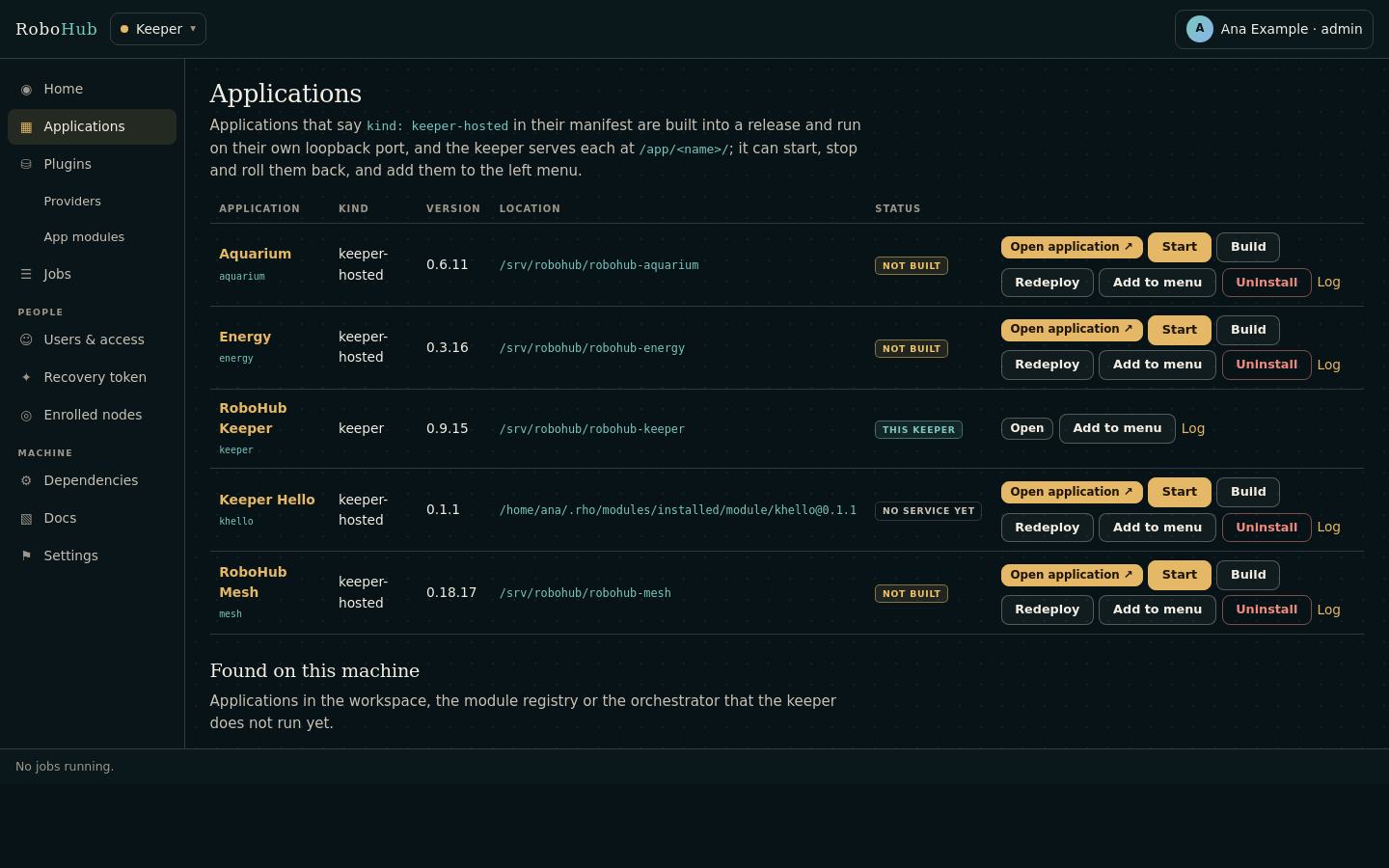
Applications /applications | The installed applications, Install, the integrations that can run here and the orchestrator's registry. |
An application /apps/<name> | Its state, where it runs, what it needs (Dependencies), its journal, its environment and its actions; Open application leads into it. |
Plugins /plugins | The plugin registry and the alert channels the keeper binds; Providers and App modules under it. |
Jobs /jobs | Builds, redeploys and starts that need a build, each with its log (/jobs/<id>). |
Users & access /people | People, their roles, their grants per application, and their sessions. |
Recovery token /auth/token | Replace the admin's access token; rotate the signing key. |
Nodes /nodes | The node identities the keeper has issued. |
System /system | What the whole machine needs: every application's and every enabled toolchain module's system dependencies. |
Docs /docs | This documentation, built from the documentation site's tree. |
Settings /settings | General, Alerts, Auth, Logging, Configuration. |
Account /account | Change one's own password. |
An application can be added to the left menu from its row; it then appears under
Applications and leads to its page in the keeper. The selection is kept in
~/.rho/keeper/menu.txt.
Installing an application
What the keeper runs is its catalogue, ~/.rho/keeper/installed.yml: one record per
application with where it came from (registry, workspace, bundled, external,
fetched or integration), where it is, its version, its port and its unit. Pages
and the API read the catalogue rather than scanning folders. On its first start the
keeper adopts what it finds on the machine; after that an application is added
through Install:
- From the Rho registry, by name —
aquariumoraquarium@0.5.0— with
rho module install. When the registry has a newer version its card says
update and its inspector offers Update to …, which installs it, points the
catalogue at it, writes the unit again and restarts. The old version stays
installed. - Found on this machine: a checkout the orchestrator's registry names, or one
uninstalled earlier. - A git URL, cloned into
~/.rho/apps/<name>(ROBOHUB_APPS_HOME). - A folder, which stays where it is.
Before anything is installed, Install shows what the application needs, at three
levels: the machine (the programs its system_deps names, as
rho doctor --path <folder> finds them), the Rho modules it names, and the
applications it depends on and the services it calls. A required program that is
missing stops it from starting; Install on that row runs rho keeper install as
a job.
An application is a module whose manifest says kind: keeper-hosted with a title, a
route, a port and a command:
module:
  name: aquarium
  kind: keeper-hosted
  title: Aquarium
  route: /
  port: "8480"
  command: aquarium
kind: keeper is the keeper itself: listed, but not started, stopped or removed from
itself. A module without such a kind (a library, a component, a documentation site)
is not an application.
Uninstall stops the application and removes its unit, its record, its releases
and its secrets (app.env, app.secret), so the same name installed again starts
afresh. Its data — its workspace — is kept. Its folder is deleted only when the
keeper cloned it.
How an application runs
Each application is a systemd user unit the keeper writes from its manifest and its
record — After=/Wants= for what deploy.depends names, Restart=on-failure,
NoNewPrivileges, and EnvironmentFile= its app.env. The unit is written again
whenever it no longer says what the keeper would write, so a moved folder or a new
port is picked up by the next start. The state a card shows comes from systemd and
the application's /healthz: running, starting, failed, stopped,
not built, no service yet. Log is the unit's journal.
Where the machine's systemd can make a private view for a user service, an
application sees the keeper's folder empty but for its own workspace and releases.
What a started application is told, in app.env (owner-only):
| Variable | What it is |
|---|---|
RHO_APP_NAME | its name in the catalogue |
RHO_APP_WORKSPACE | its workspace, ~/.rho/keeper/workspaces/<name> (ROBOHUB_APP_WORKSPACE too) |
RHO_HTTP_ADDR | where to listen: 127.0.0.1:<port>, or :<port> when the manifest says deploy.listen: lan |
RHO_APP_SECRET | a random value of its own: the seed of its forms' CSRF tokens |
RHO_AUTH_URL | the issuer that signs people in |
ROBOHUB_KEEPER_URL | the keeper, for its API |
RHO_CLIENT_ID, RHO_CLIENT_SECRET_FILE | its client of the keeper, for service tokens |
RHO_SERVICE_<NAME>_URL | each service it calls (deploy.calls) |
ROBOHUB_BUS_URL, ROBOHUB_BUS_USER, ROBOHUB_BUS_PASSWORD_FILE | the MQTT broker, when it binds the bus |
ROBOHUB_ROOT, ROBOHUB_WORKSPACE, ROBOHUB_APP_MANIFEST and RHO_KEEPER_PORT are
still written for applications that read the orchestrator's files.
Releases and rolling back
An application built from a folder runs from a release, never from the folder. A
redeploy (and the first start) builds, copies the program, its manifest, static/
and what deploy.files names into
~/.rho/keeper/apps/<name>/releases/<version>-<time>, moves the current link to it
in one rename and restarts the unit, which runs current. A rebuild in the folder
changes nothing until the next redeploy.
- A release that systemd cannot restart, or that does not answer
/healthz, is
marked.failed, the release that was in use is put back and restarted, and the
job ends failed saying which release is back. - Roll back (in the application's inspector, or
POST /api/v1/apps/<name>/rollback) puts the release made before the one in use
back; a second rollback goes further back. - The three newest releases are kept; pruning never removes the release in use or
the one before it.
| Control | What it does |
|---|---|
| Build | rho build on the folder; touches nothing that runs. |
| Redeploy | Build, make a release, write the unit, restart. A failed build leaves the running program alone. |
| Restart / Start | Restart or start the unit, writing it again first when it no longer describes the application. |
| Roll back | Put the previous release in use. |
Jobs
Building, redeploying and a start that needs a build are jobs: a script under
~/.rho/keeper/jobs/<id>/ run in the background, one at a time per application,
with its log and its outcome. The strip at the bottom of every page shows what is
running and how the last job ended. A job that says it is running but holds no lock
after half a minute is marked failed.
Signed artifacts
A signed artifact placed in ~/.rho/keeper/incoming/ is used by Redeploy when it
is the newest file for that application. The keeper verifies it, extracts it to
~/.rho/keeper/artifacts/<name>/<version>/, points the application at the new
entrypoint, restarts it and checks its health; a failed check restores the previous
target. ROBOHUB_ARTIFACT_PUBKEY is the base64 Ed25519 key that must sign artifacts;
ROBOHUB_ARTIFACT_ALLOW_UNSIGNED=1 accepts a checksum alone, for a development
machine only.
People and sign-in
The keeper is RoboHub's authorization server. The people who sign in are in
~/.rho/keeper/users.yml, owner-only, kept by the rho-auth component
(rho auth user add|verify|passwd|set|remove|list, PBKDF2). Each person has a role
and grants:
| Role | May |
|---|---|
| admin | everything: applications, installing, people, plugins, settings |
| operator | start, stop, restart, build, redeploy and roll back the applications |
| viewer | read |
Grants are what a person reaches in each application, as scopes — mesh:*,
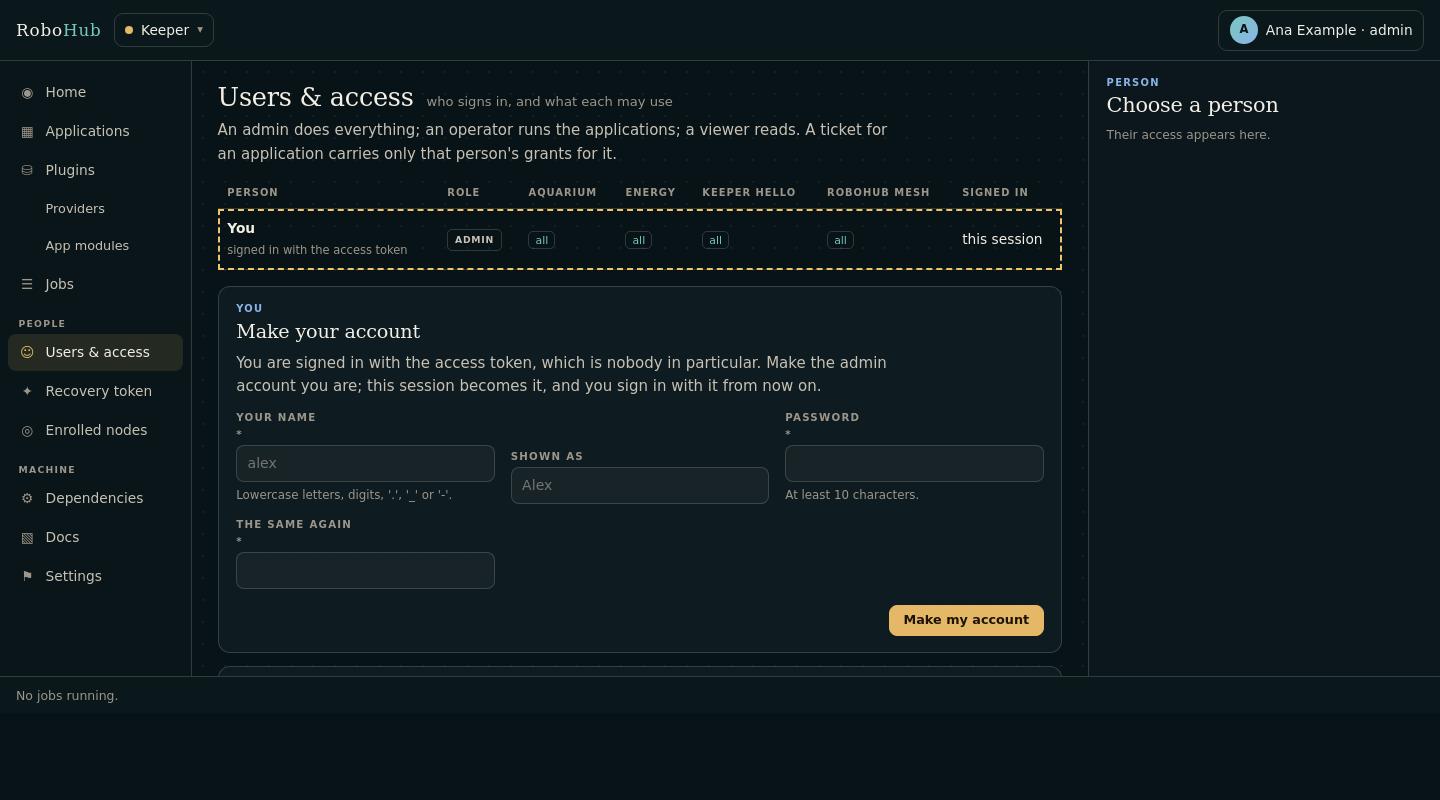
mesh:greenhouse, aquarium:read. Users & access is a matrix with a row per
person and a column per application; the inspector sets a person's role and, per
application, no access, read, everything or particular grants, and shows their
sessions and sign-in history.
The first run. The keeper makes an access token on its first start, owner-only,
in ~/.rho/auth/master.token, and a signing key pair if there is none. With nobody in
the store the sign-in page asks for the token and nothing else; it signs the admin in
afterwards too. Accounts with a name and a password are made under Users & access. A
forgotten password is reset by an admin, or from the command line:
rho auth user passwd --store ~/.rho/keeper/users.yml --name ana --password-file <file>Signing in to an application. /auth/login opens a keeper session and mints a
short-lived ES256 ticket for the application: its audience, redirect URI, a one-use
id, a 30-second lifetime, the person's name and only their grants for it (an admin's
carry *). A person with no grant is told so rather than signed in. The ticket goes
back to the application's callback: /app/<name>/auth/callback on the keeper's
origin when it is reached through the keeper, /auth/callback at the root of its
own port otherwise. Applications verify tickets with the key published at
/auth/public-key.
Sessions end together. A ticket names the keeper session by a handle derived from
it. An application asks /auth/session/<handle> at most once a minute; signing out of
the keeper, or Sign out everywhere, ends the application's session at its next
request after that. A keeper that cannot be reached signs nobody out.
Applications as clients. Every installed application is a client of the keeper
with keeper:read; rho_http_request(..., "keeper", "keeper:read", ...) gets its
service token. Its Environment tab gives it a new secret, and its client goes when it
is uninstalled.
Integrations: the MQTT broker
An integration is a plugin of kind: integration that brings a service the keeper
runs for the applications. The ones under the orchestrator's plugins/ are listed
on the Applications page; Run it records it in the catalogue, writes its
configuration under ~/.rho/keeper/services/<name>/ and starts it as a user unit.
MQTT (robohub-mqtt/index) runs Mosquitto on port 1884, on this machine
only until an admin opens it to the network for devices (Clients → Open it to the
network). Every application whose manifest binds the bus is a broker user, with a
random password in its workspace and the topics its bus: block names:
bind:
  robohub.bus:
    providers: [robohub-provider-mqtt]
bus:
  publish: [+/rpc]
  subscribe: [+/status/#, +/online]
A device is a broker user an admin adds on the Clients tab, allowed its own topic
prefix; its password is shown once. Topics shows what the broker carries, live.
Passwords are hashed by mosquitto_passwd from an owner-only file, never put on a
command line, and a change of users is read by the running broker without dropping
its connections.
Settings
| Tab | What it changes |
|---|---|
| General | Vertical or horizontal tabs on every page. |
| Alerts | The channels the keeper raises its own alerts through (an application that fails to start, stop or install): the log file and its threshold; e-mail on/off, recipient and threshold; Telegram on/off, chat, bot token and threshold. |
| Auth | A link to the recovery token page. |
| Logging | Level, text or JSON, rotating file, size, retention, standard error. |
| Configuration | Read-only: route, port, workspace, alert channels, version. |
The alert channels are the robohub.alert binding in module.yml (the log, e-mail
and Telegram providers); the Alerts tab changes them for this installation, and the
Plugins page switches a channel on or off and sends it a test.
keeper.proxy_apps=off in ~/.rho/keeper/data/settings.conf links applications on
their own ports instead of through /app/<name>/.
Registry, plugins, providers and app modules
- Registry (on the Applications page;
/modulesleads there): the repositories
the orchestrator publishes and tracks. Install clones one where its registry
entry says; Uninstall is offered only for a checkout the keeper cloned itself
(~/.rho/keeper/fetched.txt). - Plugins
/plugins: the plugin registry inplugins/registry.yml— kind,
transport, enabled — installed from a git URL or a folder, removed, enabled or
disabled for the keeper (~/.rho/keeper/plugins.txt). - Providers
/providers: the installed providers and the interface each
implements. - App modules
/app-modules: the reusable modules inmodules/registry.yml.
A module has no port or process of its own: every application that includes it
serves its routes on its own router. Removing one is refused while an installed
application uses it.
Node enrollment
Create a one-time token on the keeper's machine:
rho bootstrap token -device garden-01 -project default -area 1 -node 7The token lands in ~/.rho/keeper/enrollment.tokens, one line
token|device|project|area|node|expires|flags, added under the keeper's lock
(enrollment.tokens.lock) and with the file replaced whole. A node runs:
rho bootstrap init -config /etc/robohub/provisioning.json -token-file /run/enroll.tokenThe node generates its instance UUID and Ed25519 key locally, posts the public key
and token to POST /api/enroll over https, and stores the issued credential as a
0600 file. What the keeper holds a token to:
- it names a device and an expiry; one without either is refused, as is a used,
expired or another device's token; - the node is placed where the token says: a request naming another project,
area or node is refused; - a device already enrolled is replaced only by a token made with
rho bootstrap token -reenroll; - finding, checking and spending the token and writing the record are one step
under the lock, so a token presented many times at once enrolls once.
The record under ~/.rho/keeper/nodes/ keeps the credential only as a salted
hash (s1$<salt>$<hmac>); records an older keeper kept in the clear are hashed
when it starts. /api/enroll and /api/nodes/verify have a budget of calls per
client (the rightmost X-Forwarded-For entry the TLS proxy adds) and for all
clients together: enrollment 10 a minute per client and 60 in all, verification 60
and 600; past it they answer 429.
Nodes lists the identities issued; each can be rotated or revoked. A gateway,
Mesh or firmware checks a credential with POST /api/nodes/verify
(device_id=<device>&credential=<credential>) and receives the registered
project/area/node, or 403. That endpoint is public because the credential
authenticates it. Mesh uses it to hand a Linux host node its board key
(rho bootstrap key). The firmware side of rotation and the remaining
provisioning work are documented in the rho-bootstrap component.
API
Behind the keeper's sign-in like its pages; an application asks with its own
service token. Answers are JSON.
| Method and path | What it answers |
|---|---|
GET /api/v1/apps | every application: state, port, version, URL (and its /app/<name>/ path) |
GET /api/v1/apps/{name} | one of them |
POST /api/v1/apps/{name}/{action} | start, stop, restart, redeploy, rollback, build |
GET /api/v1/jobs | recent jobs |
GET /api/v1/jobs/{id} | one job, with its log |
GET /api/v1/registry | the orchestrator's modules: role, path here, git (?format=tsv too) |
GET /api/v1/me | who is asking: a person, or an application |
GET /api/v1/services | the services an application calls, and where |
GET /api/v1/config/{app} | an application's record and environment |
GET /api/v1/switcher | the applications for every app switcher (no sign-in; readable from this host's pages only) |
GET /api/v1/events | Server-Sent Events: app.installed, app.started, app.stopped, app.restarted, app.updated, app.rollback, app.uninstalled, job.started, job.done, job.failed, person.signed-in, person.signed-out, keys.rotated, bus.device-added |
Without a session: GET /auth/public-key, GET /auth/session/{handle},
POST /auth/service-token, POST /api/enroll, POST /api/nodes/verify, /healthz.
Security
- A form posted from another origin is refused before a handler sees it
(same_origininproject.yml): an application on its own port is another origin
of the same host, which aSameSitecookie does not tell apart. Programs that post
to the keeper send no browser headers and are not affected. - The keeper's session cookie is never forwarded to a proxied application.
- Every program the keeper runs gets its arguments one per line; a value with a line
break or a leading-is refused. ~/.rho/keeperis owner-only. Session ids, tokens and credentials come from the
runtime's random source and never pass through a report file.- Five wrong attempts close the sign-in for five minutes. Changing the access token
asks for the current one and signs out every other session.
Operating notes
| What | Where |
|---|---|
| Catalogue | ~/.rho/keeper/installed.yml |
| Releases | ~/.rho/keeper/apps/<name>/releases/, current |
| Application workspaces (their data) | ~/.rho/keeper/workspaces/<name> |
| People and sessions | ~/.rho/keeper/users.yml, ~/.rho/keeper/auth-sessions.txt |
| Access token, signing keys | ~/.rho/auth/ |
| Proxy list | ~/.rho/keeper/proxy.txt |
| Keeper's own settings | ~/.rho/keeper/data/settings.conf |
| Alerts log | ~/.rho/keeper/alerts.log |
| Deploy log | ~/.rho/keeper/deploy.log |
Logs. The keeper logs through rho.log to standard error, which the unit's
journal keeps (journalctl --user -u robohub-keeper); the Logging tab adds a
rotating file. An application's log is its own unit's journal, shown under Log.
Backup. Stop the keeper and copy ~/.rho/keeper and ~/.rho/auth: they hold
the catalogue, every application's workspace, the people and the keys. Releases can
be rebuilt; the workspaces cannot.
RHO_KEEPER_STATE_DIR names another state folder, which is what the tests use.
Release history
All notable changes to this module are recorded here, one section per release.
[0.2.0] - 2026-11-01
Mesh projects and dashboard: the keeper plans a gateway and its nodes as a tree, records each project in a workspace folder, and shows every project with its gateway status, address, last update, restart/stop/delete and project settings. The plan, network, build/program and verify steps are shown only inside a project.
Network is connection-oriented: a branch opens the link, both ends are configured, and the transport is chosen from what the two boards and robohub-transport declare. Build carries the transport into the firmware; programming shows the boot-mode instruction and waits for the acknowledgement. Long actions stream their output over Server-Sent Events with timestamps and a clearable console. Board and driver discovery is entirely runtime.
[0.3.0] - 2026-11-01
The Applications registry. A module whose manifest declares an application block is an application the keeper lists at /applications and in the left menu: keeper is the dashboard itself, and keeper-hosted is an application with its own listener that the keeper can start and stop.
The page discovers applications from applications/ on every request, installs one from a git URL, or registers a folder that already exists on the machine, and uninstalls it again without touching an external folder. Every installed application can be opened, added to or removed from the keeper's left menu, and launched from that entry. The guest application's listener is built from the browser's host and the port the manifest declares, so the link works from another machine as well.
Mesh is a keeper-hosted application of its own now: its dashboard, plan wizard and deployment state moved to applications/mesh, and the keeper no longer carries the /mesh routes.
[0.4.0] - 2026-11-02
The keeper has a plugin registry at /plugins. It lists the plugins in plugins/registry.yml, confirms each path on disk, installs one from a git URL or a folder, removes one, enables or disables it for the keeper, and sends a test alert through it. A path whose folder is gone is shown as missing.
Application failures from the applications registry now raise alerts through the configured dispatcher. The keeper's own plugin settings come from its module.yml; a dashboard toggle is written to ~/.rho/keeper/plugins.txt so the installed manifest is not edited.
[0.5.0] - 2026-11-02
A Modules registry at /app-modules for the reusable modules under modules/. It lists the installed set from modules/registry.yml, confirms each path on disk, installs one from a git URL or folder, and removes one. A module has no port or process of its own and no single host: every application that includes it serves its routes on its own router and port.
[0.5.1] - 2026-11-02
The left menu nests the current RoboHub application, the pinned applications, Modules and Plugins under Applications; Modules and Plugins are no longer separate top-level entries.
The Modules page lists modules without an Open link: a module can be included by more than one application, so there is no single host to follow. Module versions are the module's own; a host declares a dependency constraint in its app_modules entry.
[0.5.2] - 2026-11-04
Keeper is the SSO authorization server: master login, session store, ticket minting, protected admin UI and the redesigned login page. Auth is a selectable plugin, and providers are listed beside plugins.
[0.5.4] - 2026-11-05
A keeper session now stores an absolute expiry, which is what the generated auth middleware reads; a master login and the pages it protects agree again. Starting an application records the application's own pid instead of a wrapper's, so Stop works and a later Start is not told a dead instance is still running. Aquarium's menu shows the Keeper link when the keeper is the one that started it.
The keeper has an Access token page: a signed-in administrator can replace the master token, generate a random one, and copy the new token once after saving.
[0.5.5] - 2026-11-06
Deploy system: bootstrap script, per-app deploy script, deploy.port/depends metadata in module.yml, Update/Restart buttons in web UI, dependency enforcement. Fixed keeper session expiry (absolute epoch). Fixed app_start pid recording.
[0.5.6] - 2026-11-08
Reactive application rows, plugin/provider/app-module actions, and the module tree use HTMX fragments. English/Romanian UI, parent settings with alert overrides, systemd-backed application services, signed host artifact rollout with health-check rollback, and one-time node enrollment with a registry, credential verification, rotation and revocation.
[0.5.7] - 2026-11-09
Every application has a Logging form (level, text/JSON, rotating file, size, retention, stderr) and the keeper's Applications page links each app to its log. The keeper itself reads the same policy and writes to the shared logging path. Starting a bundled application that has no unit now deploys it as a user service first, so energy and future bundled apps are managed by systemd like mesh and aquarium.
[0.5.8] - 2026-11-12
The keeper finds the applications the orchestrator's registry names with role: application, by the path each entry gives, after the published ones and before the folders beside it. That is how Mesh, which has its own repository now, is listed and started.
[0.5.9] - 2026-11-12
The plugins page shows each plugin's real kind and transport, accepts a plugin that declares module.plugin_kind on install, and says "No such plugin" when there is none. Removing a provider removes the folder the registry names for it. Installing a module checks module.type: module, and module titles come from module.title. deploy-keeper.sh gives the keeper a workspace of its own (~/.rho/keeper), carrying over settings it had in the shared store, and rewrites a unit written before that.
[0.6.0] - 2026-11-12
The keeper raises its alerts through the alert interface: it binds the log, e-mail and Telegram providers in its module.yml, and the alert plugins it used to name are gone. The Settings page's Alerts tab writes each channel's settings through the binding, including whether e-mail and Telegram are on, and the Plugins page lists the bound channels apart from the installed plugins: a channel is switched on or off and sent a test through the interface, and a plugin is enabled, installed or removed as before. The Providers page shows which interface a provider implements, from its implements list. The plugin and provider registry files are the keeper's own code rather than the alert contract's.
[0.6.1] - 2026-11-12
The keeper publishes the public key its sessions and tickets are verified with, at /auth/public-key, to anyone and without a session: it is a public key. An application the keeper starts fetches it from there, and one started elsewhere is pointed at it with RHOAUTHURL, so no key is copied by hand. The smoke test checks that the published key is the keeper's.
[0.6.2] - 2026-11-12
Signing in to an application on a port of its own returns to /auth/callback at its root, and keeper signs in to itself on the port it was started on. An application row has Build and Redeploy (build, write the service unit for where the application is now, restart); a unit left behind by a moved application is written again on Start and Restart. A failed build is reported as one.
[0.7.0] - 2026-11-13
The keeper has a repository of its own, robohub-keeper, beside the orchestrator it reads through ROBOHUB_ROOT; scripts/deploy-keeper.sh deploys it from here, and listens on 127.0.0.1 unless KEEPER_LISTEN says otherwise.
Safe by default:
- A form posted from another origin, which includes every application on another port of this host, is refused before a handler sees it. - Registry install and uninstall are POSTs, and uninstall removes only a checkout the keeper cloned itself. Uninstalling an application the keeper did not fetch stops it, removes its service and stops listing it, leaving its folder alone. - Every program the keeper runs takes its arguments one per line; values with a line break or a leading
-are refused. A node's enrollment can no longer name a file outside the node folder. - The state folder is owner-only; random values come from the runtime and no secret is written to a report file. - The token is compared without stopping at the first difference, five wrong tokens close the sign-in for five minutes, and changing the token asks for the current one and signs out every other session. - Application rows loaded later get their Open links; a dependency that starts is no longer reported as one that did not, and two applications that depend on each other no longer start each other for ever.
[0.8.0] - 2026-11-13
A catalogue and a supervisor. What the keeper runs is installed.yml, adopted from what was on the machine the first time and changed only by Install and Uninstall, so pages no longer scan folders and run rho module list on every request. Each application gets a port of its own (the next free one from 8500 when its manifest's is taken) and a systemd unit the keeper writes from its manifest — After=/Wants= for its dependencies, its environment in an owner-only app.env — instead of the deploy script. State comes from systemd and /healthz: running, starting, failed, stopped, not built. Logs come from the journal.
Builds, redeploys and starts that need a build run as background jobs with a log, shown in a strip at the bottom of every page. Applications cloned from git go to ~/.rho/apps, not into the orchestrator's checkout.
/api/v1/apps and /api/v1/jobs answer programs in JSON, with the same actions the pages have, and the environment a started application is told is written down — including RHO_APP_SECRET, the seed its forms' CSRF tokens use.
The keeper takes the RoboHub look from the new shared robohub.ui module: the top bar every application will draw (brand, app switcher, the person's menu with theme and language), a rail of places, and a strip of jobs at the bottom. Home is the machine at a glance — every application as a card with one pill, and an inspector beside them with its folder, port and unit, its journal, its environment, and start, stop, restart, build and redeploy. A light theme comes from the same tokens, chosen per person and shared by every application on the host. The old explanatory home page, the unused stylesheets and the deploy script are gone.
What an application needs, at three levels: the machine (its manifest's system_deps, read with rho doctor --path), Rho (the modules it names) and RoboHub (the applications it depends on and the services it calls). A required program that is missing stops it from starting, its card says so, and its Dependencies tab installs it as a job through rho keeper install. Installing shows all of this first ("Check what it needs"), and the Dependencies page is the whole machine. The keeper, Mesh and the aquarium declare their system_deps.
Each application has a page of its own in the keeper (/apps/<name>), which the menu leads to; opening the application itself is a button there, so a menu entry no longer leaves the keeper without warning. A job that ends says so on every open page through the shared notifications module, and the install form is drawn by the shared forms module with its CSRF token.
People. Signing in is by name and password, kept by rho-auth (rho auth user, PBKDF2), with a role — admin, operator, viewer — and grants per application. The first run makes the first admin, proved by the access token on the machine; after that the token is only for recovery from the command line. A ticket for an application carries the person's own name and only their grants for it, so a person with no grant for Mesh is not signed in to Mesh; it also carries the keeper session, and /auth/session/<id> tells an application whether that still stands, so signing out — or being signed out from Users & access — ends every application's session within a minute. The keeper's own actions follow the role: installing, people, plugins and settings are an admin's; starting, stopping and redeploying an operator's. Users & access lists the people with their grants and sessions; Account changes one's own password. The sign-in page has the RoboHub look and names the application it signs in to.
Users & access is a matrix — a row per person, a column per application — with the person in an inspector: their role, and for each application no access, read, everything or particular grants. An admin signed in with the access token is shown in it, and makes the account they are from there; their session becomes it.
Every installed application is a client of the keeper, not only those that call other services: it may read the keeper's API (keeper:read), its client goes when it is uninstalled, and its Environment tab gives it a new secret. The signing key can be rotated from the recovery page; applications fetch the new public key when a ticket names it.
Applications listen on this machine only (127.0.0.1:<port>) unless their manifest says deploy.listen: lan — which is also the address a Windows browser is forwarded to under WSL, where an application on every interface could not be reached. The orchestrator is asked rather than read: /api/v1/registry, /api/v1/me, /api/v1/services and /api/v1/config/{app} answer an application with its own service token.
The first run asks for the access token and nothing else: the token in ~/.rho/auth/master.token is the admin's, and it signs the admin in afterwards too. Accounts with passwords are for other people. Wrong attempts are counted per name and every sign-in is recorded, shown in the person's inspector. The forms module draws the plugin, provider and module install forms with their tokens; those pages and the registry are cards, and the registry is part of the Applications page. An application published to the Rho registry is installed by name (name@version), and updated when a newer version is out. Pages are in Romanian through the shared i18n module's catalog of whole labels.
/api/v1/events streams what happens — installs, starts, stops, updates, jobs, sign-ins and sign-outs, key rotation — so an application listens rather than asks.
Integrations: a plugin of kind: integration brings a service the keeper runs for the applications — its program, configuration, port and system dependencies — and the first is robohub-mqtt, a Mosquitto broker on port 1884. Every application that binds the bus is a broker user with the topics its manifest names, devices are broker users an admin adds, and the broker's inspector shows its clients and its live topics. The keeper reaches the broker through the RoboHub platform's mqtt port. The broker's users are hashed in a private file of their own and moved into place only when that worked (two writes take turns, empty lines are left out), so the broker keeps the users it had if anything goes wrong; and the broker does not log the connection the keeper's health check opens.
[0.9.0] - 2026-11-13
An application built from a folder runs from a release, never from the folder: a redeploy (and the first start) builds, copies the program, its manifest, static/ and what deploy.files names into ~/.rho/keeper/apps/<name>/releases/ <version>-<time>, moves current to it in one rename, and restarts the unit, which runs current. A rebuild in the folder changes nothing until the next redeploy. The three newest releases are kept, and Roll back (on the application's page, or POST /api/v1/apps/<name>/rollback) puts the previous one back in use. The application's page says which release is in use. The keeper deploys itself the same way: scripts/deploy-keeper.sh builds, makes a release and restarts on it every time it runs (--status only reports).
[0.9.1] - 2026-11-13
The clock sign-in, sessions and enrolment use is read from the process (rho_now_s) instead of from date written to a fixed file, which two requests at once could truncate under each other and make a session expire at once. Built on rho-sql 0.2.1.
[0.9.2] - 2026-11-13
Correctness fixes from the 2026-11 review.
- A redeploy whose release systemd cannot restart, or which does not answer, puts the release that was in use back and restarts it; the job ends failed saying which release is back, and the new one is marked
.failed. Before, the broken release stayed in use and systemd restarted it in a loop. - A rollback goes to the release made before the one in use, by the time in its name; a second rollback goes further back instead of returning to where the first started. Pruning never removes the release in use or the one before it. - A job that says it is running but holds no lock after half a minute (killed, a restart, a lost race for the lock) is marked failed, so the application is not busy for ever. - The smoke test binds to 127.0.0.1, and covers a release that answers, one that does not, two rollbacks and a stale job.
[0.9.3] - 2026-11-13
Built on provider-email 0.2.1, provider-webhook 0.2.1, provider-log 0.2.1 and notifications 0.1.6.
[0.9.4] - 2026-11-13
- Uninstalling an application removes its releases and its secrets (app.env, app.secret), so the same name installed again starts afresh; its data is kept. - An application's name may not contain a dot, which the catalogue would read back as a record of its own.
[0.9.5] - 2026-11-13
An application's app.env quotes HOME and PATH, as systemd's environment file reads a value whole: unquoted, WSL's PATH stopped at /mnt/c/Program and the Windows directories after it — powershell.exe among them — were lost, so Mesh could not reach a board through Windows to flash it.
[0.9.6] - 2026-11-13
A mesh gateway's page can be signed in to. The gateway takes keeper's tickets for the audience gateway but is started by Mesh rather than hosted by the keeper, so its sign-in was refused as "not one this keeper signs in to". The keeper now signs in to the audience gateway when the ticket goes back to /auth/callback on this machine or on the host the keeper was reached on, on whatever port the mesh gave it, and nowhere else.
[0.9.7] - 2026-11-14
Trimming, URL decoding and form fields come from the toolchain (rho 0.7.0) rather than the keeper's own copies; a % not followed by two hex digits in a form is kept as written instead of becoming a zero byte. Needs rho 0.7.0.
[0.9.8] - 2026-11-14
From a security review.
- A sign-in ticket names the keeper session by a handle derived from it, never by the session id the keeper's cookie carries: an application, or anything that reads its ticket, could otherwise present it back to the keeper as the admin.
/auth/session/{handle}answers by the handle. - The docs page no longer reflects its address as markup, and refuses a path with... - The app switcher's list is readable from a page of this host only, not from any site (Access-Control-Allow-Originwas*). -next,return_toandaudienceare URL-encoded on their way through sign-in. - Hosted applications run withNoNewPrivileges, and — where the machine's systemd can make a private view for a user service, which the keeper tries once — with the keeper's folder empty in their view but for their own workspace and releases, and the keys that mint tokens hidden. - A manifest'sdeploy.callscannot name*. - Enrollment: area and node must be numbers, and a token not made for a device cannot take over one already enrolled.
[0.9.9] - 2026-11-14
- The keeper declares one port, 19090, and a keeper started by hand listens there on loopback. - Uninstalling a module is refused while an installed application uses it, and deletes its folder only when the keeper fetched it. -
deploy-keeper.shreads the manifest with awk and no longer needs PyYAML.
[0.9.10] - 2026-11-14
Its function for a hosted app's workspace is keeper_app_workspace, apart from the toolchain's app_workspace(); HTML is escaped by escape_html (rho 0.8.0).
[0.9.11] - 2026-11-14
Every page, fragment, notice and confirmation of the keeper — the sign-in page included — is written with i18n keys (609 in each of English and Romanian, the same set), where hard-coded English was translated afterwards by matching whole phrases, which missed about four in ten, any message with a value in it and every confirmation. The phrase catalog and its pass are gone. Messages the keeper keeps (job reasons, the sign-in history, logs) stay English and are translated when shown; API answers stay English.
[0.9.12] - 2026-11-14
The applications the keeper hosts are served under its own origin, at /app/<name>/ (rho 0.8.1's app_proxy), and the keeper's links and the app switcher send a person there rather than to their ports. Cookies are scoped by host, not by port, so on its own port an application received the keeper's admin session with every request; through the keeper it never does, and its own cookies are scoped to its path. An application signs in through the keeper's origin too. keeper.proxy_apps: off in the keeper's settings goes back to ports. Needs rho 0.8.1.
[0.9.13] - 2026-11-14
The top bar is drawn in the request's language by robohub.ui itself (the whole-word swap is gone), and the switcher list carries each application's state in the reader's language.
[0.9.14] - 2026-11-14
Translated sentences are filled with the toolchain's str_replace (rho 0.8.3) rather than a helper the i18n module keeps for itself.
[0.9.15] - 2026-11-14
The Applications page says how an application is run today: kind: keeper-hosted in its manifest, built into a release, on its own loopback port and served at /app/<name>/, instead of an application block and a port of its own.
[0.10.0] - 2026-11-14
Enrollment trusts the token, not the node: the place a node is enrolled into is the one its token names, a token names a device and an expiry, an enrolled device is replaced only by a re-enroll token, and a token is spent once even when two requests race. Node credentials are stored salted and hashed. Enrollment and node verification are rate limited by the connection's own address (a forwarded address only from a proxy on this machine). Needs rho 0.9.0.