This page was generated from the source of RoboHub. Edit the source, not this page.
How it fits
RoboHub is a handful of programs on one machine and a tree of gateways and
boards around it. Each layer knows only the one below it, through a named
interface, so a part can be replaced without the others noticing.
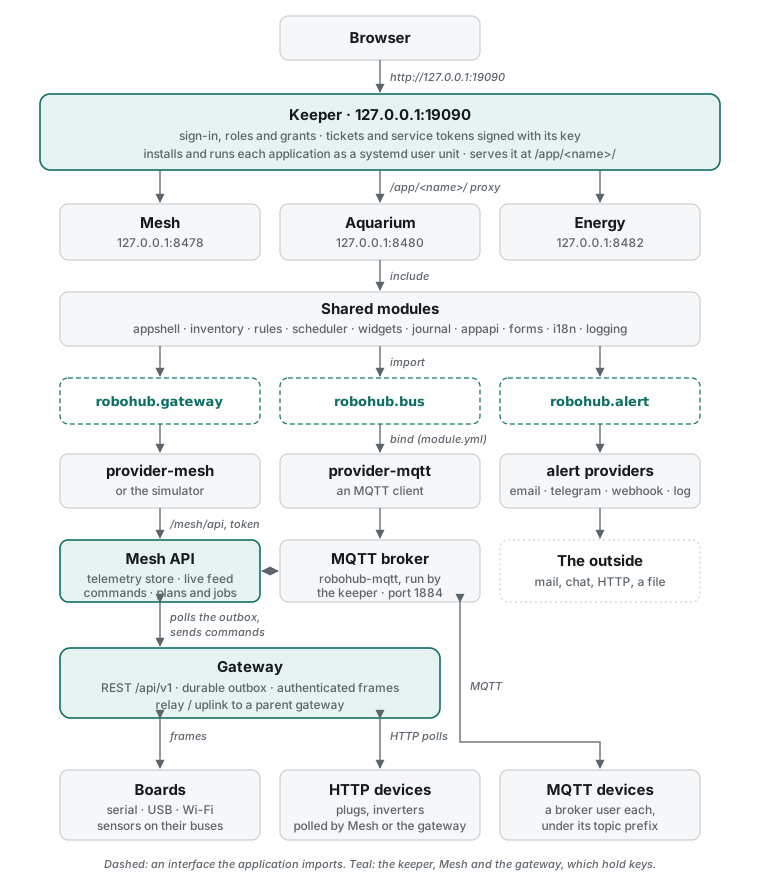
From the top
The browser talks to one address: the keeper, 127.0.0.1:19090.
The keeper signs people in and holds the only signing key. It installs the
applications, runs each as a systemd user unit on its own loopback port, and
serves them at /app/<name>/ on its own origin, so one address — and one TLS
proxy, if there is one — reaches all of them. See keeper/index.
The applications — Mesh, Aquarium, Energy — are each one HTTP service on
one port. An application is mostly shared modules: it includes them, they
register their routes on its router, and it defines a few host_* functions
that make them its own (build/host-application).
The interfaces are how an application reaches anything outside itself:
| Interface | For | Providers |
|---|---|---|
robohub.gateway | sources, readings, history, the live feed, switching an output | robohub-provider-mesh, the simulator |
robohub.bus | MQTT topics | robohub-provider-mqtt |
robohub.alert | an alert on every channel the application binds | robohub-provider-email, -telegram, -webhook, -log |
An application lists the providers in bind: in its module.yml; only those
are compiled in, and its Settings page changes their configuration on a running
installation.
Mesh is an application and the one owner of telemetry. Through its API
(/mesh/api) the other applications read sources, history and the live feed and
send actions; behind it, Mesh plans each mesh, builds and flashes its boards,
runs its gateway and polls it. See mesh/index.
The gateway is the edge. It reads authenticated frames from boards over
serial, USB or Wi-Fi, polls network devices, keeps a durable outbox of readings
for Mesh, and answers commands. A gateway can run as a relay that reports through
a parent gateway's uplink. See robohub-gateway/index.
Boards and devices are the hardware: boards running RoboHub firmware with
sensor modules on their buses, and network devices — plugs, inverters — reached
over HTTP or through the keeper's MQTT broker.
Ports
| What | Listens on |
|---|---|
| Keeper | 127.0.0.1:19090 |
| Mesh, Aquarium, Energy | 127.0.0.1:8478, :8480, :8482 — or the next free port from 8500 |
MQTT broker (robohub-mqtt) | 127.0.0.1:1884, or every interface when opened for devices |
| A mesh's gateway | its REST port and uplink port, given by Mesh per mesh |
More
- architecture/reading — one reading from a sensor to a widget or a rule.
- architecture/enrollment — how boards and nodes get an identity.
- architecture/security — sign-in, tokens and scopes, the proxy,
isolation. - The firmware stack, networking on a board and
secure telemetry — the design underneath.